

Veterinary anesthesia machine with 1 vaporizer
Veterinary anesthesia machine with 1 vaporizer
Model: MCS0160
Gas Anesthesia Machine Veterinary Overview:
Introducing our Gas Anesthesia Machine Veterinary – an indispensable anesthesia device that plays a pivotal role within surgical suites. Its core function involves delivering vital oxygen and anesthetic agents to patients undergoing anesthesia procedures, alongside proficient ventilation management to ensure secure and seamless surgeries.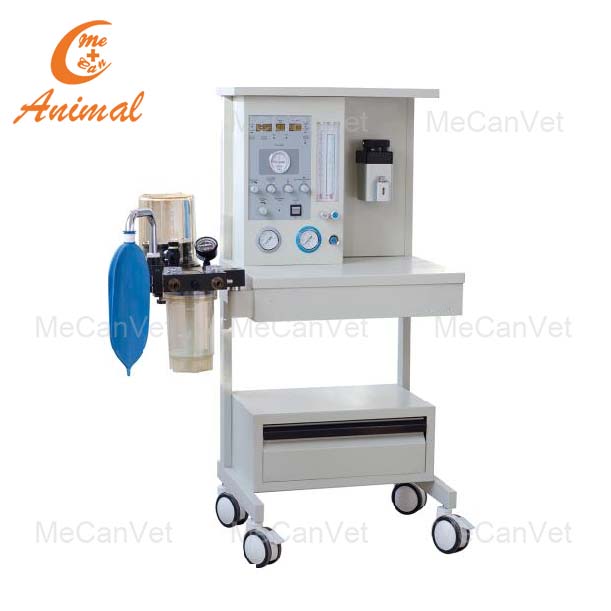
Key Features of Gas Anesthesia Machine Veterinary :
- Dedicated Anesthetic Vaporizer: Equipped with a high-precision anesthetic vaporizer, ensuring accurate control of anesthetic agent concentrations.
- Safety Mechanisms: Incorporates safety features to prevent cyanosis, coupled with an alarm system for patient security.
- Synchronized Anesthesia Respirator: Employs a microcomputer-controlled pneumatic synchronized anesthesia respirator for precise patient respiratory management.
- Standard Interfaces: Each connecting component adheres to standard interface protocols, promoting convenient connectivity and operation.
- Efficient Absorber: Features a high-capacity soda lime absorber, significantly minimizing patient re-inhalation of carbon dioxide.
Technical Parameters of Gas Anesthesia Machine Veterinary:
Gas requirement: | Medical oxygen and nitrous oxide with a pressure ranging from O2: 0.32~0.6MPa ; NO2: 0.32 MPa to 0.6 MPa. |
safety valve | <12.5 kPa |
Respiratory Rate | 4~40bpm |
Flow meter | O2:0.1~10L/Min, N2O:0.1~10L/Min |
oxygen concentration in the mixed gas N2O/O2 | >21% |
Oxygen Flush: | 25~75 L/min |
Maximum error of the pressure testing device | not exceed ± (4% of the full scale reading + 8% of the actual reading) |
modes of ventilation | A/C,IPPV, SIPPV, MANUAL |
I/E Ratio: | 1:1.5; 1:2.0;1:2.5; 1:3 |
Tidal Volume | 0~1500ML |
Controlled ventilation and assisted ventilation switching time | 6s |
Maximum safety pressure: | ≤ 12.5 kPa |
Pressure limit range: | 0 ~ 6.0 kPa |
Airway pressure alarm: Audible and visual and with yellow and red color indicating | Lower: 0.2kPa~5.0kPa; Upper: 0.3~6.0 kPa |
±0.2 kPa | |
Tidal volume alarm: Audible and visual and with yellow and red color indicating | upper alarm: 50 to 2000ml,lower alarm: 0~1800ml |
Power Supply Alarm | Ac/dc power supply are after failing to send out alarm immediately |
Gas Anesthesia Machine Veterinary's Operating Conditions:
- Ambient Temperature: 10 ~ 40 ℃
- Relative Humidity: Not exceeding 80%
- Atmospheric Pressure: 860 hPa ~ 1060 hPa
- Power Requirements: ~220-240V, 50/60Hz, 40VA, must be grounded effectively
- Air Source Requirements: Medical oxygen and nitrous oxide, with rated pressure ranging from 0.3 to 0.5MPa


